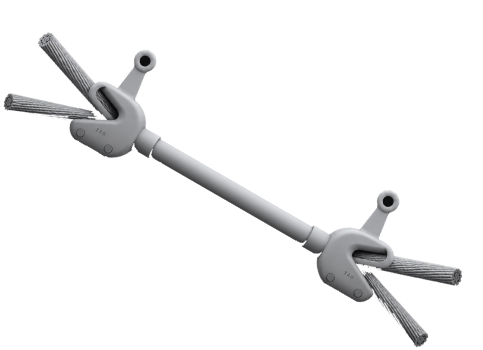

Spacer Dampers
Two jobs, one fitting: hold the bundle's geometry, and stop the wind-induced vibration that fatigues it. TAG's articulated spacer damper does both — proven from −30°C to +50°C.
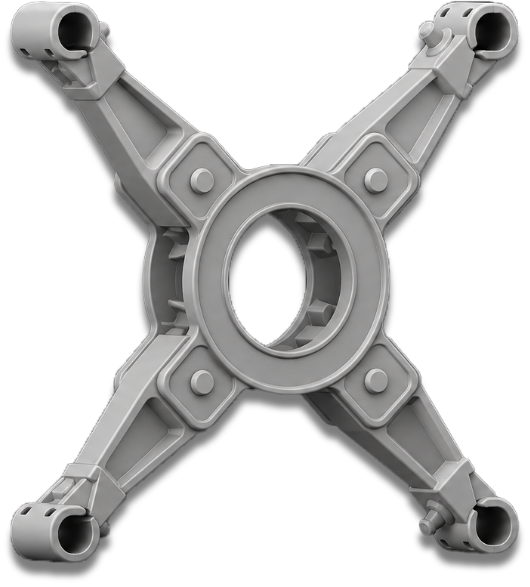
Bundled conductors never stop moving. Steady wind sets them oscillating — aeolian vibration at low speeds, sub-span oscillation at higher ones — and over years that motion fatigues strands, loosens clamps, and wears conductors until something fails. A spacer damper solves both at once: it holds the sub-conductors at fixed spacing and dissipates that vibration energy before it can do damage — protecting conductors, fittings, and towers for the life of the line.
A spacer damper only performs if four things are right — the geometry, the metal, the elastomer, and the proof. TAG controls all four, in-house, in Chennai. That's not a pedigree claim; it's why the damper works.
Every damper is engineered to your line, not pulled from a shelf. Bundle configuration, sub-conductor diameter, spacing, and span all feed the design, so the fitting is tuned to the conductor it will actually hold.
The body is forged, not cast — giving it the grain structure and fatigue strength to survive decades of the very vibration it exists to damp. The part that fights fatigue can't itself fatigue.
The elastomer is the damping. By moulding it in-house, TAG controls the exact compound and hardness that decide how much vibration energy the damper dissipates — and how it holds that behavior from −30°C to +50°C, from arctic cold to desert heat. This is the heart of the articulated design.
Every design is type-tested in TAG's own ISO/IEC 17025-accredited laboratory — vibration endurance, mechanical, electrical, and high-current — before it ever ships.
Compatibility
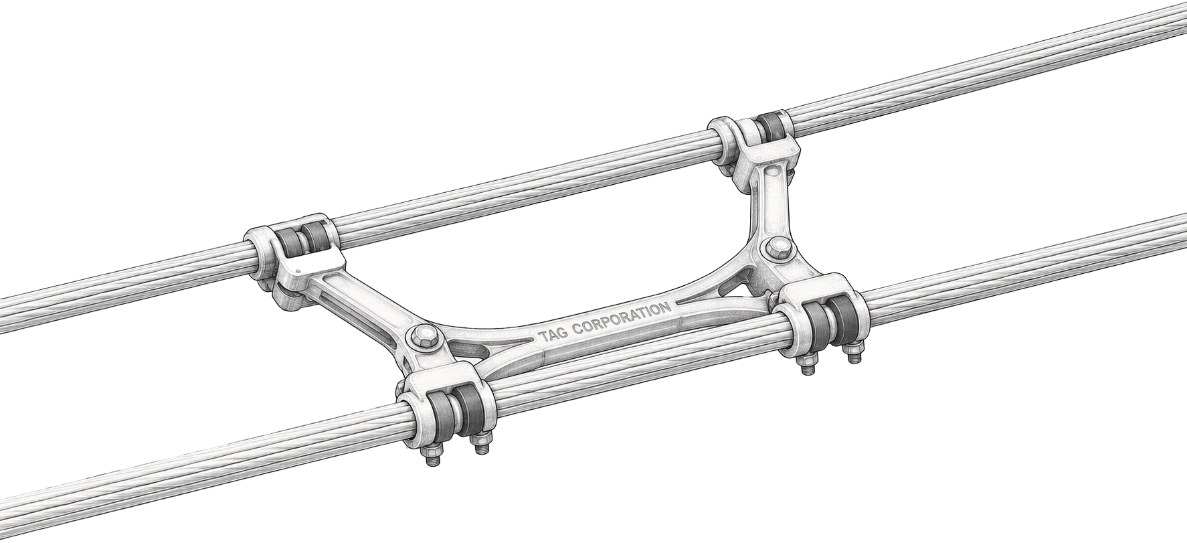
Bundle configurations
twin, triple, quadruple, asymmetrical, hexagonal, octagonal
Conductor types
conventional, HTLS, and ACCC®
Environments
high wind, ice, coastal, seismic
Select your bundle.
Cross-sections show conductor positions in the bundle. Select a configuration to view indicative parameters — final specifications are engineered to your line design.
Detailed specifications for this configuration are coming soon.
Detailed specifications for this configuration are coming soon.
Detailed specifications for this configuration are coming soon.
Detailed specifications for this configuration are coming soon.
Detailed specifications for this configuration are coming soon.
Detailed specifications for this configuration are coming soon.
Proven against every way a damper can fail
A spacer damper faces four forces on the line — vibration, mechanical load, electrical stress, and fault current — plus the two things that define whether it's actually a damper: its damping response and the elastomer that delivers it. Every design is type-tested against all six in TAG's ISO/IEC 17025-accredited laboratory before it goes into production.
TAG has worked with Hydro-Québec
to redesign, test, and manufacture the articulated spacer damper — engineered to hold up from −30°C to +50°C, from arctic cold to tropical heat.
Thirty-two years of designs proven in ice, wind, and heat.
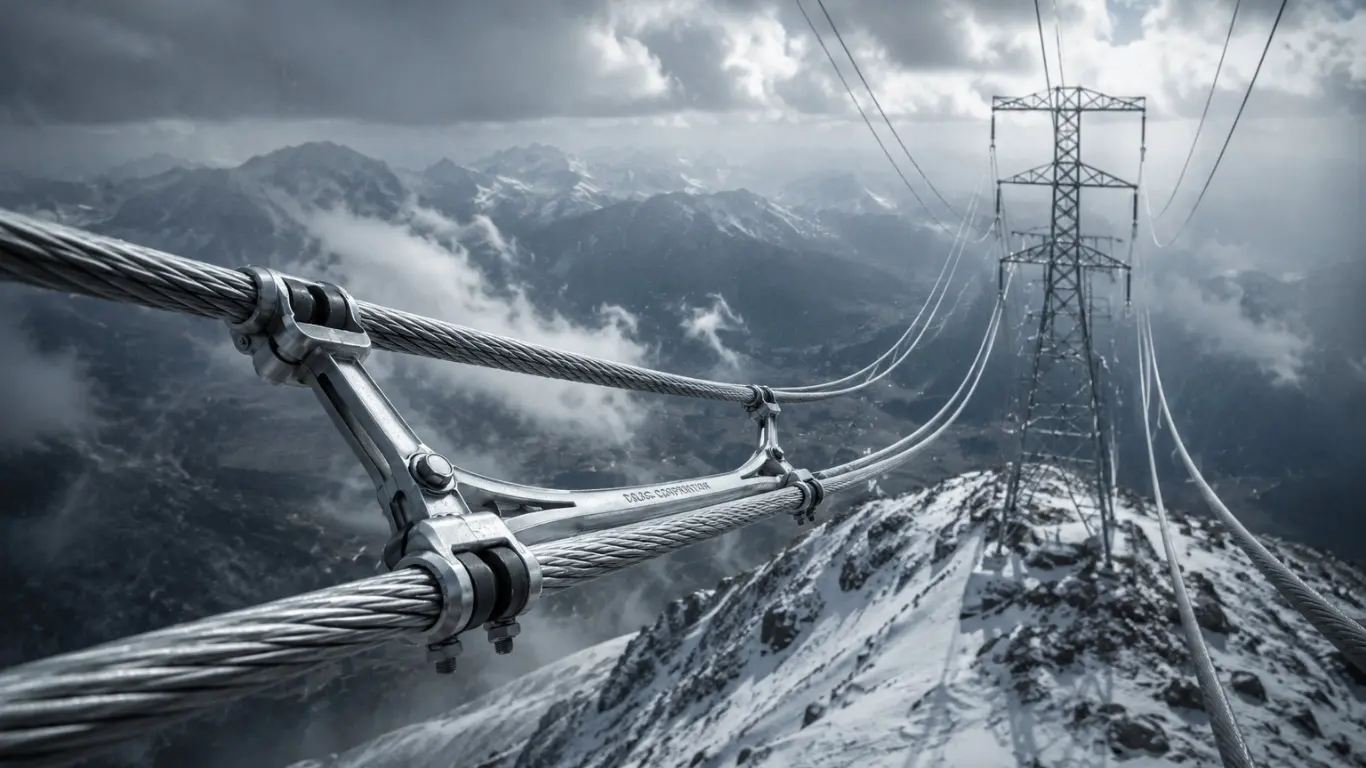
Over a million spacer dampers, holding the highest-voltage lines in the country.
TAG has supplied more than 1,000,000 spacer dampers across 180 lines at 765kV — the top of India's transmission network, where bundles run six and eight sub-conductors and vibration control isn't optional. On the 765kV Agra–Greater Noida line alone, TAG's dampers hold the bundle steady across some of the grid's most heavily loaded corridors.